
If you’re over 50 and dealing with nagging pain or stiffness, it’s very easy to assume it’s “just age.”
In reality, a lot of the problems I see in clinic aren’t caused by age alone – they’re driven by a handful of very fixable daily habits.
I’m Will Harlow, over-50s specialist physio at HT Physio in Farnham, and in this post I want to walk you through five common habits that quietly create pain and stiffness in your back, hips, knees, shoulders and neck and what you can do instead.
DISCLAIMER: The information in this post is not a substitute for individualized medical advice and the exercises are not suitable for every person. Please get checked out before you start any new exercise programme.
1. Sitting for too long in one position
You’ve probably heard the phrase “sitting is the new smoking.” I don’t think it’s quite that dramatic, but there’s no doubt that long periods in the chair cause problems, especially after 50.
When you sit:
- Your hip flexors (the muscles at the front of your hips) are shortened.
- They attach to your spine, so when you stand up, those tight muscles can tug on your lower back.
- Over time this can lead to lower back pain, hip discomfort and that “stiff for the first 10–15 steps” feeling when you get up.
What to do instead
- Aim to change position at least every 30 minutes.
That doesn’t mean you have to go for a walk each time (although that’s ideal). Even just standing up, straightening your body and moving for 30–60 seconds helps. - Try this simple hip flexor stretch to undo sitting:
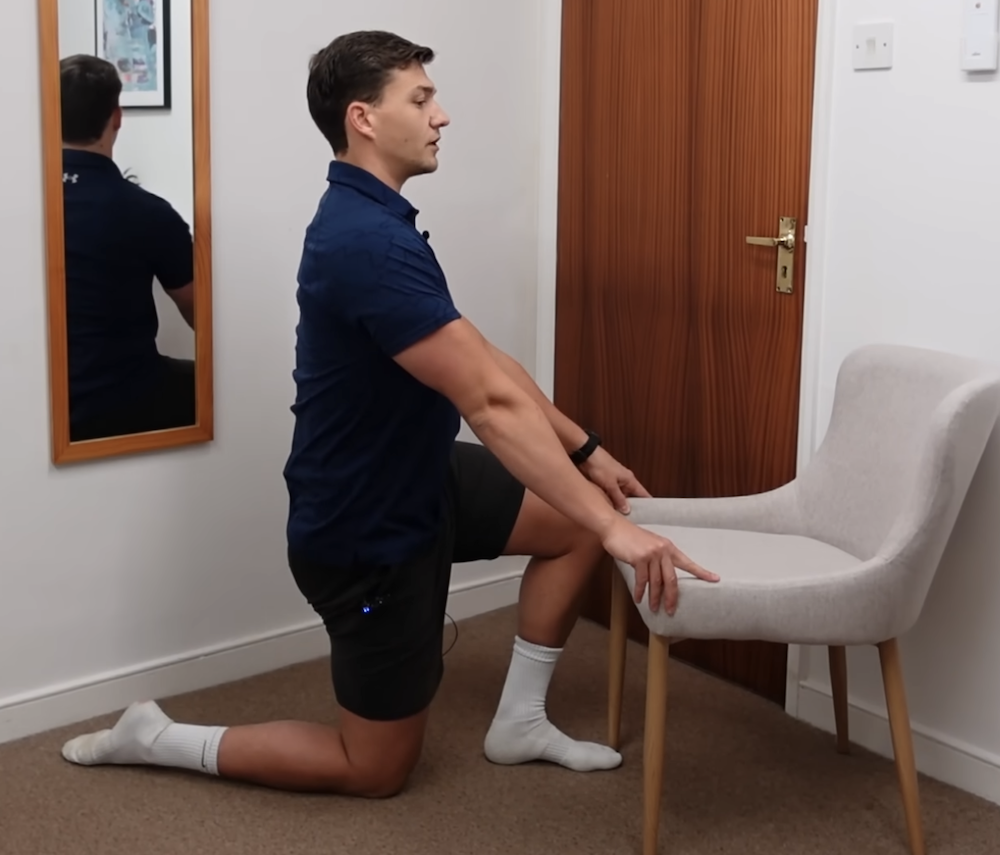
Option 1 – Kneeling hip flexor stretch
- Kneel on one knee (use a cushion under the knee if needed).
- Hold onto a chair or surface for balance.
- Gently tuck your pelvis under (imagine zipping up a tight pair of trousers) and squeeze your bottom.
- You should feel a stretch at the front of the hip and thigh of the kneeling leg.
- Hold for 30 seconds, repeat 2–3 times per side.
Option 2 – Standing version (if kneeling isn’t comfortable)
- Stand with one leg behind you, toes on the floor.
- Keep your torso upright.
- Gently tuck your pelvis under, just as above.
- You should feel a stretch at the front of the hip of the back leg.
- Hold for 30 seconds, repeat 2–3 times per side.
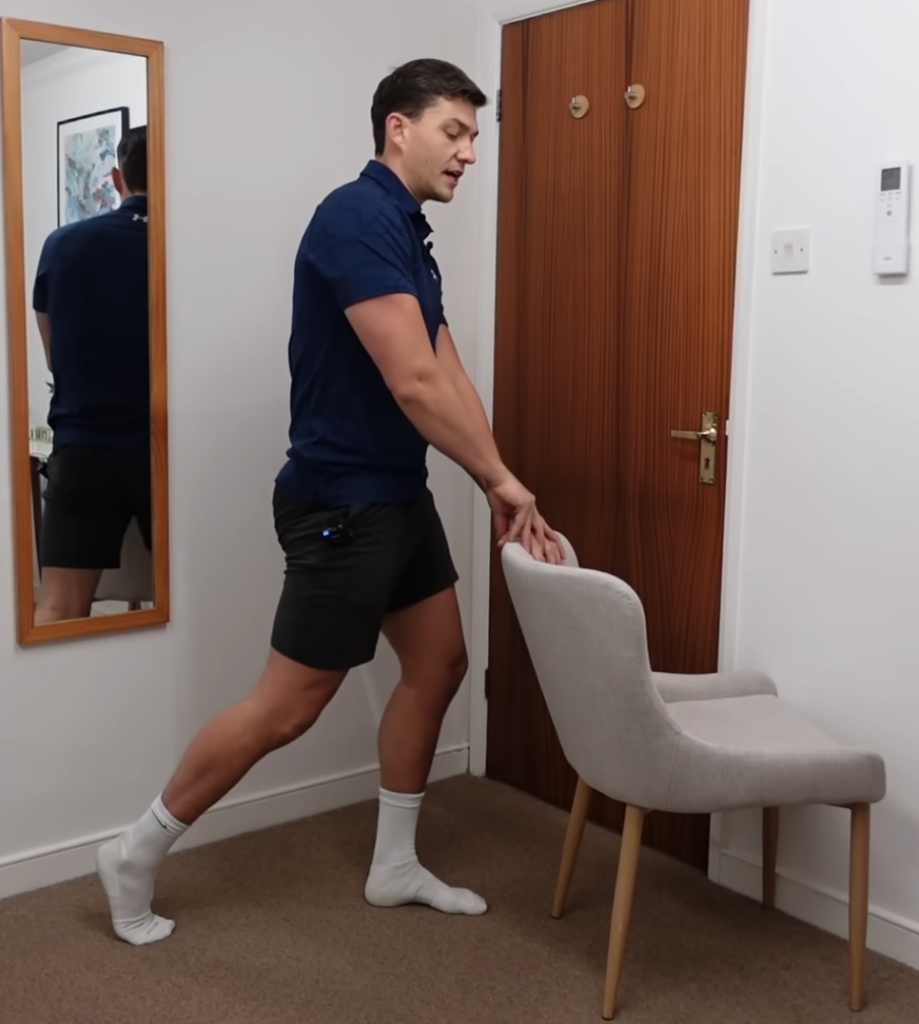
Do this a few times a day, especially on days when you’re sitting a lot.
2. Over-relying on ergonomic chairs
This one surprises a lot of people.
Ergonomic office chairs aren’t bad, in fact, they can be very helpful. But there’s a downside: if your chair does all the work, your muscles don’t have to.
With:
- Lumbar (lower back) support
- Shoulder support
- Headrest
- Armrests
…your postural muscles (core, back, shoulders) can go on “holiday.” Over months and years, that can leave you weaker and more vulnerable to pain when you’re not in that perfect chair, for example, when lifting, walking, gardening or travelling.
What to do instead
You don’t need to throw your chair away. You just need more variation:
- Alternate between sitting and standing, using a sit–stand desk if you have one.
- When sitting, spend some time perched on the front of the chair, rather than always leaning back into the support. Sit tall and let your postural muscles do some of the work.
- If appropriate for you, consider short periods on a gym ball (under supervision at first). The slight instability encourages your core to switch on.
Think of ergonomic support as something to use, not something to live in.
3. Collapsing into a rounded posture
We all do this one:
- Leaning over a laptop
- Peering at a phone or tablet
- Slouching on the sofa with the chin poking forward
Over time, this “C-shaped” posture can lead to:
- Neck pain
- Shoulder tightness
- Upper back stiffness
- Headaches
The muscles at the back of your neck and shoulders work overtime, while the chest muscles become tight and the upper back muscles become weak.
Better positions
- Lift your chest (sternum) slightly and lengthen the back of your neck.
- Bring phones and tablets up towards eye level, rather than dropping your head down to them. Use cushions or armrests to prop your elbows up.
- When working on a laptop, sit closer to the screen with your back tall and shoulders relaxed.
A simple exercise to undo rounding: band pull-aparts
If it’s safe for you to do so and you have a light resistance band, try this:
- Stand tall with the band held out in front of you at chest height, hands shoulder-width apart.
- Keeping your shoulders relaxed, pull the band apart, bringing your hands out wide so the band comes across your chest.
- Focus on squeezing your shoulder blades together.
- Pause for a second, then slowly return to the start.
- Repeat 8–10 times, a few times a day.
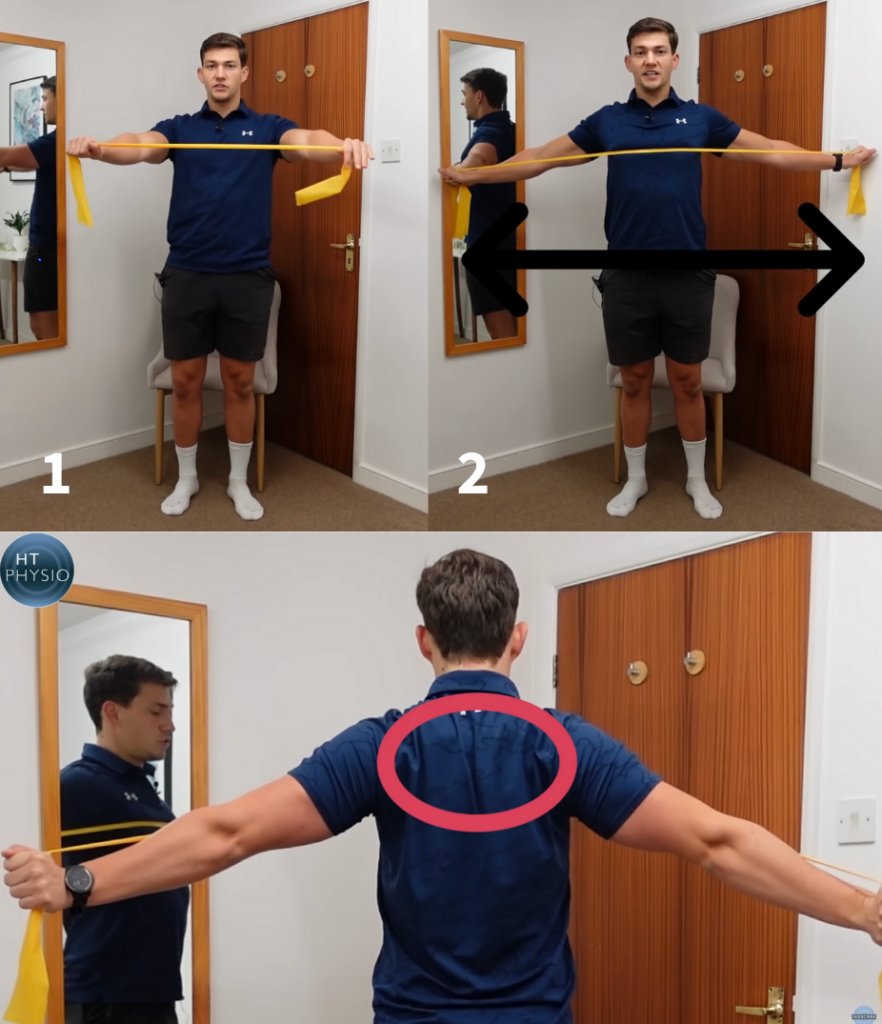
This strengthens the muscles that help hold you upright and counteracts that forward-slumped posture.
4. Using your hands to get in and out of chairs
This is a sneaky habit that quietly weakens your legs over the years.
Pushing up with your hands from the armrests or thighs takes a huge amount of work away from your leg muscles. It might feel easier in the moment, but long term it means:
- Weaker thighs and hips
- Less support for arthritic knees or hips
- Greater risk of falls and difficulty with stairs and hills
A better approach
Whenever it’s safe to do so, practice getting up and down using your legs only:
- Scoot towards the front of the chair.
- Place your feet flat on the floor, shoulder-width apart.
- Lean your nose over your toes and push through your legs to stand, keeping your hands away from the chair.
- When sitting down, control the descent, don’t just drop. Aim to “land like a feather.”
You’ll probably sit and stand 10–15 times per day without thinking about it. If you use each one of those as a mini leg exercise, your strength adds up quickly, without changing your schedule at all.
If you can’t yet do this without using your hands, that’s okay, it just tells us your legs need attention. You can gradually reduce how much help your hands give over time.
5. Holding your breath when you move
This one is very common in people with pain.
You go to bend, lift or stand up and without realising you brace and hold your breath. It’s usually a subconscious way of “preparing for pain.”
The problem is, breath-holding:
- Tells your nervous system that something threatening is happening
- Makes muscles tighten even more
- Reduces smooth, relaxed movement
- Often increases the pain you were bracing against
A simple breathing fix
A useful rule of thumb is:
breathe out during the “hard” or lowering part of the movement.
For example:
- Bending to pick something up → exhale as you bend
- Sitting down → exhale as you lower
- Going downstairs on a painful knee → gently exhale as that leg takes the load
Your exhale doesn’t have to be noisy. It can be a quiet breath, but making it slightly more deliberate at first helps you break the breath-holding habit.
Over time, this:
- Calms the nervous system
- Reduces unnecessary muscle tension
- Often leads to smoother, less painful movement
Bringing it all together
To recap, the five habits I most often see causing pain and stiffness over 50 are:
- Sitting too long in one position
- Over-relying on ultra-supportive ergonomic chairs
- Allowing a rounded, slumped posture to become the default
- Using your hands to get up and down from chairs
- Holding your breath during movements, especially painful ones
You don’t need to fix all five at once. In fact, I’d suggest you:
- Pick one habit that you recognise in yourself.
- Make a simple change (e.g. standing every 30 minutes, or doing sit-to-stands without hands).
- Stick with it for a week or two.
- Then build from there.
Small, consistent tweaks to how you sit, move and breathe can make a big difference to pain, stiffness and independence over time.
Next Steps
If you’d like more expert-led strategies like this one, check out my book Thriving Beyond 50, it’s full of practical exercises and insights designed to help you stay strong, mobile, and independent for years to come.
Or, if you live near Farnham, you can book an assessment at HT Physio to get a personalised walking or balance improvement plan.
Author:
Will Harlow, MSc, MCSP. Over-50s Specialist Physiotherapist, HT Physio – Farnham, UK